A semicircle has diameter and chord of length parallel to . A smaller semicircle with diameter on and tangent to is cut from the larger semicircle, as shown below.
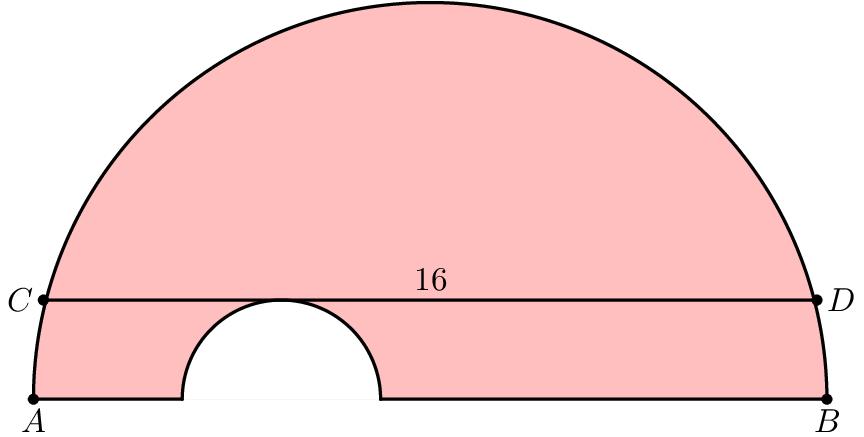
What is the area of the resulting figure, shown shaded?
- A)
- B)
- C)
- D)
- E)
Answer
C
Key insight
Tangency makes the small radius equal CD's height above AB, so the half-chord 8 gives R^2 - r^2 = 64 and the area is 32pi.
Solution
Let the large semicircle have radius and centre on , and let the small semicircle have radius . Let be the distance from to the parallel chord .
The small semicircle has its diameter on , so its highest point is exactly above . Being tangent to means that highest point lies on , so
Now drop the perpendicular from to . It bisects the chord, so it meets at distance from , and the radius is the hypotenuse of a right triangle with legs and :
The shaded figure is the large semicircle with the small one removed:
The answer is .
Why this works
Neither nor is determined by the given data, and neither is the position of the small semicircle along ; only the combination is pinned down, and that is exactly what the area difference needs. Whenever a shaded region is the difference of two circles or semicircles, look for a right triangle whose legs are a half-chord and the gap between the two boundaries: the Pythagorean theorem hands over directly. The same trick solves the classic "annulus determined by a tangent chord" problem, where a chord of length tangent to the inner circle gives ring area .
Alternative approach
Since the answer cannot depend on , choose a convenient case: let the small semicircle be tangent to at its midpoint and take so that . Setting gives , and the area is ; setting gives and . Two agreeing special cases confirm the general computation.
The trap
Subtracting whole-circle areas instead of semicircle areas, which doubles the answer to 64pi, choice (E).
Common mistakes
- Subtracting whole-circle areas instead of semicircle areas, which doubles the answer to 64pi, choice (E).
- Assuming the small semicircle is concentric with the large one; the figure shows it off-centre, and tangency alone already forces wherever it sits.
- Trying to solve for and separately; they are not determined, and only is needed.
Techniques
Add construction lines/points (drop altitudes, extend segments, connect centers) · Cut the figure into known shapes (triangles, rectangles, sectors)