In the figure below is a rectangle with and . Point lies , point lies on , and is a right angle. The areas of and are equal. What is the area of ?
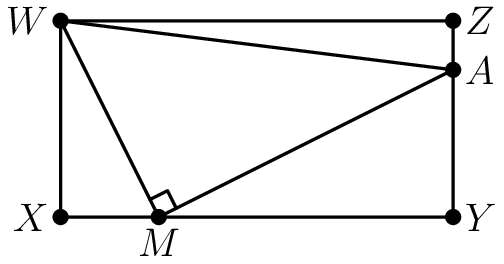
Note: On certain tests that took place in China, the problem asked for the area of .
- A)
- B)
- C)
- D)
- E)
Answer
C
Key insight
Equal areas force XM = 2 ZA; the right angle at M makes WXM and MYA similar, pinning ZA = 1; subtract three corner triangles from 32.
Solution
Let , so . Triangle has legs and ; triangle has legs and . Equal areas give , so and .
At the angles and add to (they flank the right angle on a straight line). In right triangle , is also complementary to , so and the right triangles and are similar, with and :
So and . Then , , , .
Subtract the three corner triangles from the rectangle:
The answer is .
Why this works
A right angle whose vertex sits on a side of a rectangle always produces a pair of similar right triangles in the two adjacent corners; that is the standard "folded right angle" configuration. The equal-area condition supplies one relation between the unknown segments, the similarity supplies the other, and the target triangle is easiest to measure by subtraction rather than directly.
Alternative approach
With and , apply the Pythagorean theorem to the right triangle : becomes , which simplifies to . The root would put at and collapse the figure, so , and .
The trap
Solving the similarity proportion but then reporting the area of a corner triangle (like MYA = 9) instead of the rectangle minus all three corners.
Common mistakes
- Solving the similarity proportion but then reporting the area of a corner triangle (like MYA = 9) instead of the rectangle minus all three corners.
- Setting from "equal areas" without accounting for the different legs and ; the correct relation is .
Techniques
Set up the equation/formula and compute; no special trick needed · Cut the figure into known shapes (triangles, rectangles, sectors)