Square is rotated clockwise about its center to obtain square , as shown below. What is the degree measure of ?
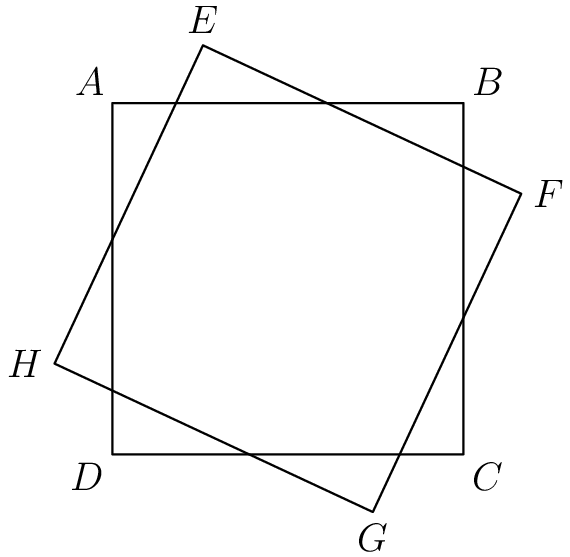
- A)
- B)
- C)
- D)
- E)
Answer
B
Key insight
All eight corners lie on one circle around the center. Angle EAB is half of arc EB, and arc EB is 90 minus 20 = 70 degrees.
Solution
Let be the center of the squares. Turning a shape around keeps each corner the same distance from , so we can use a circle.
1. Draw the circle. All eight corners are the same distance from , so they all lie on one circle with center .
2. Arc . and are neighboring corners of a square, and the four corners split the circle into four equal arcs. So arc is .
3. Where is. is where lands after turning clockwise, so is on arc , past . That leaves
4. Angle at . has its corner on the circle, and its two sides cut off the arc . An angle like this (called an inscribed angle) is half of the arc it cuts off:
The answer is .
Why this works
When a shape is turned around its center, every point stays the same distance from the center, so a circle through the corners is the natural thing to draw. On that circle, the turning angle becomes an arc, and the rule "an angle with its corner on the circle is half its arc" changes arcs into the angle you want.
Alternative approach
Skip the circle and use a triangle instead.
- Triangle has (both are the distance from the center to a corner), and the angle at is the turn, .
- The two equal angles at and share the remaining , so each is . That means .
- The line runs along the diagonal of square , and a diagonal cuts the corner in half, so .
- Seen from , the side lies between the lines and , so .
The trap
Answering the rotation angle 20 degrees, or computing 45 minus 20 = 25, without working out the angle at A.
Concise solution
Let be the common center. Rotating about keeps every vertex at the same distance from , so all eight vertices lie on one circle centered at . Draw that circle.
On this circle, and are adjacent vertices of a square, so arc measures . The vertex is the image of under a clockwise rotation, so it sits on arc with arc . Hence arc .
is an inscribed angle intercepting arc , so
The answer is .
Review in the AoPS books
- Introduction to Geometry, Chapter 16: The More Things Change. . . (§16.1, §16.2, §16.3, §16.4)
- Introduction to Geometry, Chapter 11: Circles
- Introduction to Geometry, Chapter 2: Angles
- Introduction to Geometry, Chapter 19: Problem Solving Strategies in Geometry (§19.1)
Techniques
Add construction lines/points (drop altitudes, extend segments, connect centers)