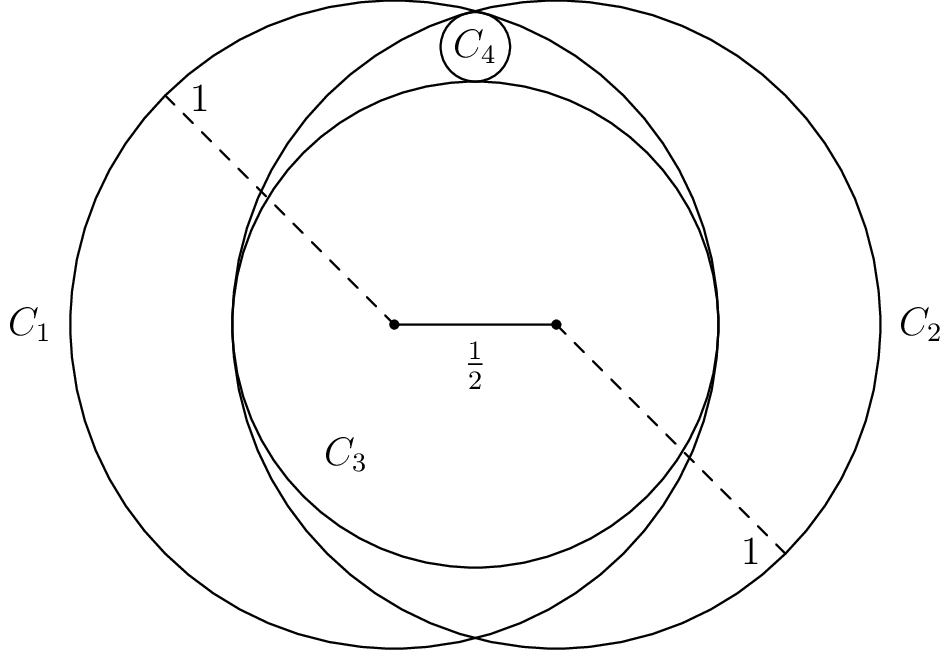
Circle and each have radius , and the distance between their centers is . Circle is the largest circle internally tangent to both and . Circle is internally tangent to both and and externally tangent to . What is the radius of ?
- A)
- B)
- C)
- D)
- E)
Answer
D
Key insight
C3 is centered at the midpoint with radius 3/4; C4's center is on the perpendicular bisector, so a right triangle with legs 1/4, 3/4+r and hypotenuse 1-r gives r.
Solution
Let and be the centers of and , and the midpoint of , so .
The largest circle inside both and is centered at : it must fit inside the lens-shaped overlap, and the circle centered at of radius touches both big circles internally. So has center and radius .
By symmetry the center of lies on the perpendicular bisector of , directly "above" . Let be its radius. External tangency with gives . Internal tangency with gives .
Triangle has a right angle at , so
Expanding: , so and .
The answer is .
Why this works
Tangency conditions are distance conditions between centers: difference of radii for internal, sum for external. Once the centers are located (here two of them by symmetry), the problem is a single right triangle. Look for the line of symmetry first; it usually turns a tangent-circle configuration into one Pythagorean equation.
Alternative approach
Coordinates: , with . Then , the same equation.
The trap
Using external tangency (distance = 1 + r) between C4 and C1, or taking C3's radius as 1/2 instead of 3/4.
Common mistakes
- Using external tangency (distance = 1 + r) between C4 and C1, or taking C3's radius as 1/2 instead of 3/4.
- Squaring as and losing the cross term .
Techniques
Add construction lines/points (drop altitudes, extend segments, connect centers) · Set up the equation/formula and compute; no special trick needed