Each square in a grid of squares is colored red, white, blue, or green so that every square contains one square of each color. One such coloring is shown on the right below. How many different colorings are possible?
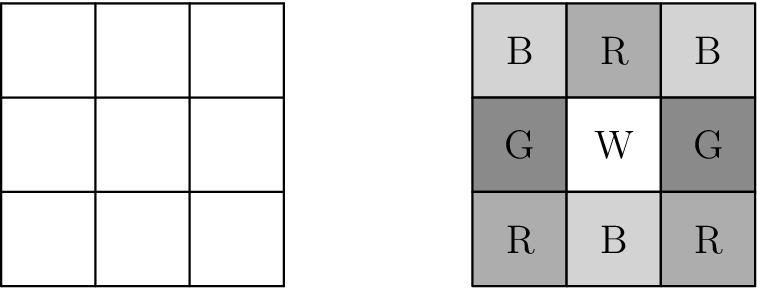
- A)
- B)
- C)
- D)
- E)
Answer
D
Key insight
The center is in every 2x2 block; the four edge-middle squares form a cycle colored with the other 3 colors (18 ways), and the corners are then forced.
Solution
The center square belongs to all four blocks, so no other square may share its color. Choose the center's color: ways. The remaining eight squares use only the other colors.
Label the edge-middle squares (top), (right), (bottom), (left). Each block contains two of them that are adjacent around the ring ( with , with , with , with ), and those two must differ. Opposite squares ( and , or and ) share no block and may match. So we need colorings of a -cycle with colors where neighbors differ:
- Both opposite pairs equal (, , different colors): .
- Exactly one opposite pair equal: choose which pair (), its color (), then the other two squares take the remaining two colors in either order (): .
- Neither pair equal: impossible, since would need colors with and and all four neighbors distinct, requiring colors.
That gives ring colorings.
Each corner lies in exactly one block, together with the center and two adjacent ring squares, all three of different colors; the corner must take the fourth color, so it is forced.
Total: .
The answer is .
Why this works
Start with the most constrained cell (the center, in every block), then the next tier (edge squares, each in two blocks), and let the least constrained cells (corners, one block each) be determined last. Reducing the middle tier to "proper colorings of a cycle" is the reusable step; for a -cycle with colors the count is , which for is .
The trap
Treating the edge-middle squares as independent choices, or forgetting the two cases (two opposite pairs equal vs. one pair equal) in the cycle count.
Common mistakes
- Treating the edge-middle squares as independent choices, or forgetting the two cases (two opposite pairs equal vs. one pair equal) in the cycle count.
- Counting the corners as free choices, or believing each of the blocks can be colored in ways independently.
Techniques
Split into exhaustive cases and handle each · Exploit symmetry to reduce work or pair up objects