Each square in a grid is either filled or empty, and has up to eight adjacent neighboring squares, where neighboring squares share either a side or a corner. The grid is transformed by the following rules:
- Any filled square with two or three filled neighbors remains filled.
- Any empty square with exactly three filled neighbors becomes a filled square.
- All other squares remain empty or become empty.
A sample transformation is shown in the figure below. 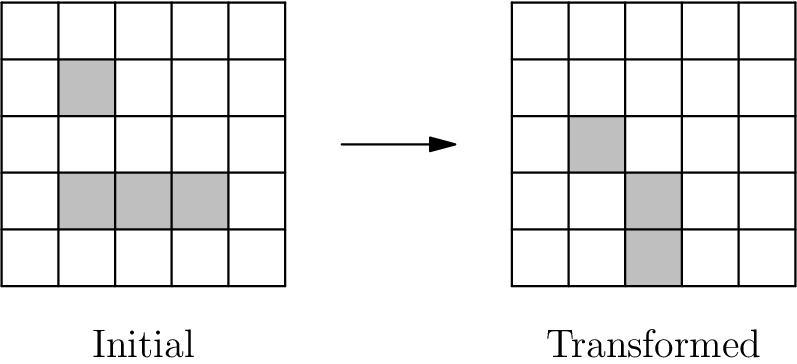 Suppose the grid has a border of empty squares surrounding a subgrid. How many initial configurations will lead to a transformed grid consisting of a single filled square in the center after a single transformation? (Rotations and reflections of the same configuration are considered different.)
- A)
- B)
- C)
- D)
- E)
Answer
C
Key insight
Only 2 or 3 outer cells can be filled; translate 'everything else ends empty' into adjacency rules on the 8-cell ring and count by how many corners are used.
Solution
The center's neighbors are the "outer" cells of the (four corners, four edge-midpoints). For the center to end filled, either the center is filled with or filled outer cells, or it is empty with exactly .
Everything else must end empty. A border cell can only reach filled neighbors if a whole side of the is filled, so no side may be full. A filled outer cell must not have or filled neighbors; an empty one must not have exactly . Adjacency on the ring: each corner touches its two neighboring edge cells; each edge cell touches every other edge cell except the opposite one.
Center filled. Each filled outer cell already sees the center, so it may touch no other filled cell. Three pairwise non-adjacent outer cells always leave some empty cell seeing exactly (e.g. the edge between two of three corners): . Two non-adjacent cells with no empty cell touching both: only two diagonally opposite corners, .
Center empty, 3 filled outer cells. No filled cell may touch both others, no empty cell may touch all three, no full side.
- Three corners: always fine, .
- Two same-side corners plus an edge: only the opposite edge works, .
- Two diagonal corners plus an edge: any edge works, .
- One corner plus two edges: opposite edges fail (the empty edge beside the corner sees all three); two adjacent edges plus the corner touching neither, .
- Three edges: two are opposite and the third touches both, .
Total .
The answer is .
Why this works
The rule set only lets a cell survive or be born with two or three filled neighbors, so the target "one filled center" caps the number of filled cells immediately. After that, the problem is pure adjacency bookkeeping on an -cell ring, and organizing the cases by how many corners are used exploits the symmetry so each case is a one-line check.
Alternative approach
Complementary check for the center-empty case: of the triples, discard those where a filled cell touches both others, where an empty cell touches all three, or which fill a side. Each discarded family is small and symmetric; the survivors number , matching the casework above.
The trap
Forgetting that empty cells with exactly three filled neighbors turn on, including the border midpoints when a full side of the 3×3 is filled.
Common mistakes
- Forgetting that empty cells with exactly three filled neighbors turn on, including the border midpoints when a full side of the 3×3 is filled.
- Treating the "center filled" case as impossible or as allowing three filled neighbors, which shifts the total to 20 or 26.
Techniques
Organized listing / direct enumeration · Split into exhaustive cases and handle each