Let , , and be squares that have vertices at lattice points (i.e., points whose coordinates are both integers) in the coordinate plane, together with their interiors. The bottom edge of each square is on the -axis. The left edge of and the right edge of are on the -axis, and contains as many lattice points as does . The top two vertices of are in , and contains of the lattice points contained in See the figure (not drawn to scale). 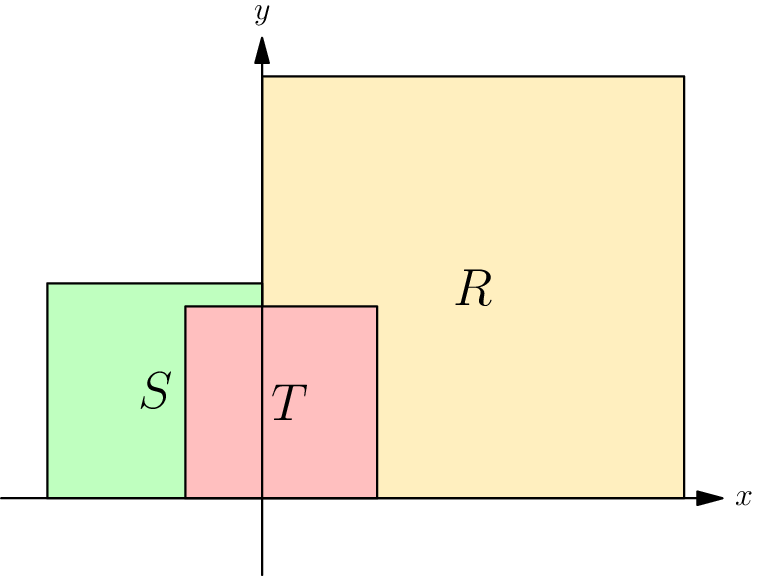 The fraction of lattice points in that are in is times the fraction of lattice points in that are in . What is the minimum possible value of the edge length of plus the edge length of plus the edge length of ?
- A)
- B)
- C)
- D)
- E)
Answer
B
Key insight
A lattice square of side n has (n + 1) squared points. Every condition becomes a count, giving one whole-number equation plus a remainder condition.
Solution
Step 1: counting lattice points. A square of side with lattice-point corners has points in each row and rows, so points. For example, side gives points.
Step 2: squares and . Let the sides be , , . We are told , so . That means is even. Write
sits to the right of the -axis and to the left. They share only the points on the -axis from up to , which is points. So and together contain
Step 3: square . has a quarter of those points:
Step 4: where sits. must cross the -axis (if it were entirely on one side, one of the two fractions would be and the other not). Say runs from to . Its top corners are in , so is no taller than . Counting columns times rows:
- and share the columns , which is columns, each with points.
- and share the columns , which is columns, each with points.
Step 5: the "27 times" condition. has points and has , so
Cancel and multiply both sides by : , so
Step 6: what this says about . Let , the number of columns of on the side. Then , and has columns (the -axis column was counted in both). So is one less than a multiple of .
Step 7: combine with Step 3. Write . We need with .
- Since is one less than a multiple of , is one more than a multiple of , so is more than a multiple of .
- is a multiple of minus .
- So must be a multiple of , which means is a multiple of :
- Also must be even, since otherwise is odd while is even. That leaves
Step 8: try them in order.
- : . Not a perfect square (, ).
- : . And , so works.
Step 9: read off the sides and check. gives , , , and . runs from to with height . Its top corners and lie in and . Every larger makes all three sides bigger, so this is the smallest total:
The answer is .
Why this works
Every statement about the squares is really a lattice-point count, and each count is either a square or columns times rows. Translating them gives one equation in whole numbers plus a condition on remainders. Remainder and even/odd checks shrink the search to a short list, and the geometry is checked at the end.
The trap
Counting lattice points as the area, n squared, instead of (n + 1) squared, or counting the shared points on the y-axis twice when counting R and S together.
Concise solution
A lattice square of side contains lattice points. Let the sides be . From put and . Squares and overlap only in the points on the -axis, so has points, and .
Let occupy with ; its top vertices lie in and , so also . Counting columns times rows, has points and has . The stated condition is
Writing gives and , so .
Now solve . Modulo : , so . The product must be even, so is even; together, .
- : , not a square.
- : , and has the required form (, ).
Hence , , ; indeed and , so 's top vertices lie in . Larger only enlarges every side, so the minimum is .
The answer is .
Review in the AoPS books
- Introduction to Geometry, Chapter 17: Analytic Geometry
- Introduction to Number Theory, Chapter 7: Algebra With Integers
- Introduction to Number Theory, Chapter 12: Introduction to Modular Arithmetic
- Intermediate Algebra, Chapter 20: Some Advanced Strategies (§20.2)
Techniques
Organized listing / direct enumeration · Substitute to simplify (u = x+1/x, shifting, scaling)