What is the area of the shaded figure shown below? 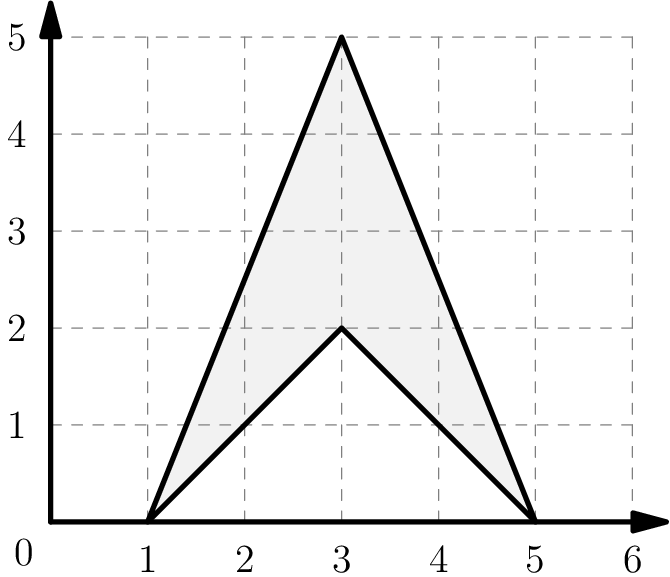
- A)
- B)
- C)
- D)
- E)
Answer
B
Key insight
The shaded arrowhead is the tall triangle with vertices (1,0), (5,0), (3,5) minus the short triangle (1,0), (5,0), (3,2), both sharing base 4.
Solution
The shaded region has vertices , , and ; it is an arrowhead pointing up, with a notch at .
Fill in the notch: the large triangle with vertices , , has base (along the -axis) and height , so its area is .
The notch itself is the triangle with vertices , , : base , height , area .
Shaded area .
The answer is .
Why this works
A concave polygon is often easiest to handle as a convex shape minus a bite. Both triangles here share the same base, so the answer is simply : the shaded region has the same area as a triangle with base and height .
Alternative approach
Shoelace formula on in order: the cross terms give , and half the absolute value is .
The trap
Reading the notch vertex (3,2) as (3,1) or (3,3) off the grid, or adding the two triangles instead of subtracting.
Common mistakes
- Reading the notch vertex (3,2) as (3,1) or (3,3) off the grid, or adding the two triangles instead of subtracting.
- Treating the figure as two triangles split by the vertical line but using the wrong heights for them.
Techniques
Cut the figure into known shapes (triangles, rectangles, sectors)