A farmer's rectangular field is partitioned into by grid of rectangular sections as shown in the figure. In each section the farmer will plant one crop: corn, wheat, soybeans, or potatoes. The farmer does not want to grow corn and wheat in any two sections that share a border, and the farmer does not want to grow soybeans and potatoes in any two sections that share a border. Given these restrictions, in how many ways can the farmer choose crops to plant in each of the four sections of the field? 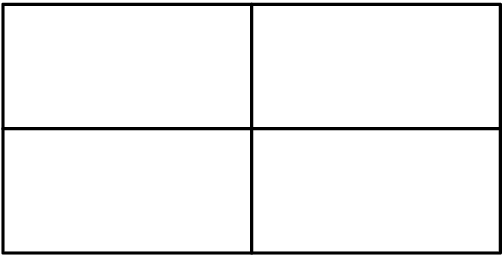
- A)
- B)
- C)
- D)
- E)
Answer
C
Key insight
Diagonal cells never touch: fix them first; then each of the other two cells has 3 options if the diagonal pair matches and 2 otherwise: 36 + 48.
Solution
Each crop has exactly one "enemy" (corn–wheat, soybeans–potatoes). In the grid, each section borders the two sections beside and below/above it but not the diagonally opposite one. So the two diagonal sections and are unrestricted with respect to each other, while each of the other two sections and borders both and .
Choose the crops of and first, then count options for (and identically for ).
Case 1: and get the same crop ( ways). Then must avoid just one enemy, leaving choices; same for . Total .
Case 2: and get different crops ( ordered ways). Now must avoid the enemy of and the enemy of . These are two different crops (distinct crops have distinct enemies), so has choices; same for . Total .
Adding: .
The answer is .
Why this works
The adjacency structure of a grid is a -cycle, and the diagonal pair is the natural thing to fix: once those two are set, the remaining two cells are independent of each other and face identical constraints. Casework on "same or different" for the fixed pair keeps the count to two lines. In general, look for a set of mutually non-adjacent cells whose choice decouples the rest.
Alternative approach
Group crops into families corn, wheat and soybeans, potatoes. Adjacent cells from different families are always fine; adjacent cells from the same family must be identical. Assign families to the four cells, then pick one crop per connected block of same-family cells: all one family gives ; three-and-one gives ; two adjacent and two adjacent gives ; two diagonal and two diagonal gives . Total .
The trap
Treating diagonally opposite sections as sharing a border, or forgetting that a section may repeat a neighbor's crop (only the two enemy pairs are forbidden).
Common mistakes
- Treating diagonally opposite sections as sharing a border, or forgetting that a section may repeat a neighbor's crop (only the two enemy pairs are forbidden).
- In Case 2, using options for when the two fixed crops are enemies of each other; the forbidden crops are then 's and 's own crops, still two of them.
Techniques
Split into exhaustive cases and handle each