2020 AMC 10B Problem 10
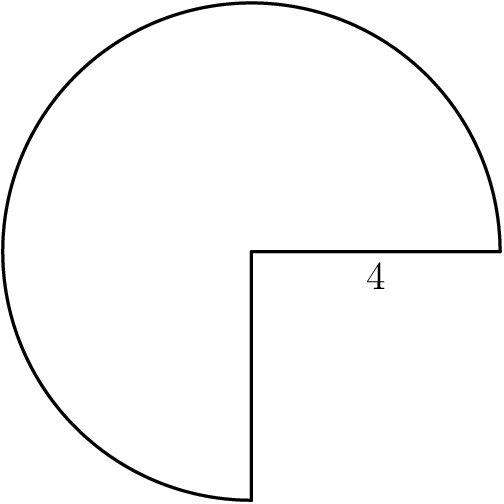
A three-quarter sector of a circle of radius inches together with its interior can be rolled up to form the lateral surface area of a right circular cone by taping together along the two radii shown. What is the volume of the cone in cubic inches?
Show solution without answering
Key insight
When the sector is rolled up, its radius 4 becomes the slanted side of the cone, and its curved edge wraps around the base. That makes the base radius 3.
Solution
Picture rolling the paper sector into a cone. Two lengths carry over:
- the straight edges (the radius ) run from the tip of the cone down to the rim, so they become the slant height, ;
- the curved edge wraps once around the bottom, so it becomes the circumference of the base.
1. Length of the curved edge. A full circle of radius has circumference . The sector is three quarters of the circle, so its curved edge is .
2. Base radius. The base circle has circumference , so and .
3. Height. The height, the base radius and the slant height form a right triangle, with the slant height as the longest side:
4. Volume. A cone has volume :
The answer is .
Why this works
Rolling paper does not stretch it, so lengths are kept. The sector's radius becomes the slant height and its arc becomes the base circumference. Those two facts give the base radius, and the Pythagorean theorem gives the height. Every "roll a sector into a cone" problem follows these same three steps.
Concise solution
A shorter write-up, the way contest solutions are usually written. It may take a different route from the solution above.
When the sector is rolled up, its radius becomes the slant height of the cone, and its arc becomes the circumference of the base.
Arc length of a three-quarter sector of radius : . Setting gives base radius .
Height from the right triangle with hypotenuse and leg :
Volume:
The answer is .
Review in the AoPS books
- Introduction to Geometry, Chapter 14: Three-Dimensional Geometry
- Introduction to Geometry, Chapter 11: Circles
- Introduction to Geometry, Chapter 15: Curved Surfaces
- Introduction to Geometry, Chapter 12: Circles and Angles
Similar problems
Problem © Mathematical Association of America (MAA), American Mathematics Competitions. Reproduced for non-commercial educational use. Solution and commentary are original to this site.