As shown in the figure below, a regular dodecahedron (the polyhedron consisting of congruent regular pentagonal faces) floats in empty space with two horizontal faces. Note that there is a ring of five slanted faces adjacent to the top face, and a ring of five slanted faces adjacent to the bottom face. How many ways are there to move from the top face to the bottom face via a sequence of adjacent faces so that each face is visited at most once and moves are not permitted from the bottom ring to the top ring? 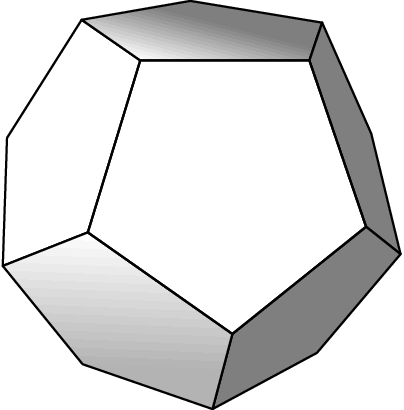
- A)
- B)
- C)
- D)
- E)
Answer
E
Key insight
Routes factor into stages: entry face on the top ring (5), walk along it (9), step down (2), walk the bottom ring (9): 810.
Solution
Each face of the top ring touches the top face, its two ring neighbors, and two faces of the bottom ring (its remaining two edges). Likewise each bottom-ring face touches the bottom face, two ring neighbors, and two top-ring faces.
Since a route cannot return to the top face and cannot climb from the bottom ring back to the top ring, every route has the shape: top face, some faces of the top ring, some faces of the bottom ring, bottom face.
Stage 1: choose the first top-ring face: ways.
Stage 2: wander along the top ring without repeating. The ring is a -cycle, so from the entry face you can stop immediately ( way) or move or steps clockwise or counterclockwise ( ways): ways in all, each ending at a definite face.
Stage 3: from the final top-ring face, step down to one of its adjacent bottom-ring faces: ways.
Stage 4: wander along the bottom ring: again ways.
Stage 5: step onto the bottom face: way.
Total: .
The answer is .
Why this works
The "no upward moves" rule makes the route pass through the layers in order, so the count factors into independent stages. Within a cycle of faces, the number of simple walks from a fixed start is , because any other face can be reached going either direction. Model the solid as a layered graph and the geometry disappears.
The trap
Counting only 5 ways to traverse a ring (one per exit face) instead of 9, since every non-entry face can be reached going either way around, which gives 250.
Common mistakes
- Counting only 5 ways to traverse a ring (one per exit face) instead of 9, since every non-entry face can be reached going either way around, which gives 250.
- Assuming each top-ring face touches only one bottom-ring face, or forgetting that a route may pass through several faces of the same ring.
Techniques
Set up the equation/formula and compute; no special trick needed · Exploit symmetry to reduce work or pair up objects