A paper triangle with sides of lengths and inches, as shown, is folded so that point falls on point . What is the length in inches of the crease? 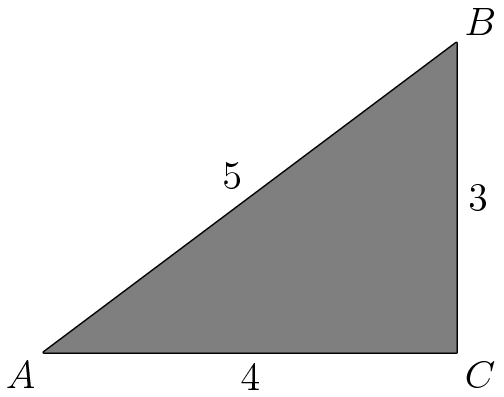
- A)
- B)
- C)
- D)
- E)
Answer
D
Key insight
Folding A onto B makes the crease the perpendicular bisector of AB; it meets AB at its midpoint and forms a right triangle with angle A whose tangent is 3/4.
Solution
In the figure the right angle is at , with , , and hypotenuse .
Folding onto reflects across the crease, so the crease lies on the perpendicular bisector of . Let be the midpoint of , so , and let the crease meet leg at . The crease inside the paper is segment .
Triangle has a right angle at and shares angle with the big triangle. In , , so in
(Also , confirming really lies on rather than beyond .)
The answer is .
Why this works
Every fold is a reflection, and the crease is the mirror line: the perpendicular bisector of the segment joining a point to its image. Once that line is identified, the crease is trapped inside a small right triangle similar to the original one, and a single ratio finishes it. Ask "which side does the crease exit through?" before computing; here it exits through the longer leg.
Alternative approach
Coordinates: , , . The midpoint of is and the perpendicular slope is , so the bisector is . It hits at ; the distance from to is .
The trap
Assuming the crease runs to the opposite vertex or to leg BC, or measuring the crease as the whole perpendicular bisector rather than the part inside the triangle.
Common mistakes
- Assuming the crease runs to the opposite vertex or to leg BC, or measuring the crease as the whole perpendicular bisector rather than the part inside the triangle.
- Using (the ratio for the other acute angle), which gives , not among the choices, or using instead of and getting .
Techniques
Add construction lines/points (drop altitudes, extend segments, connect centers) · Set up the equation/formula and compute; no special trick needed