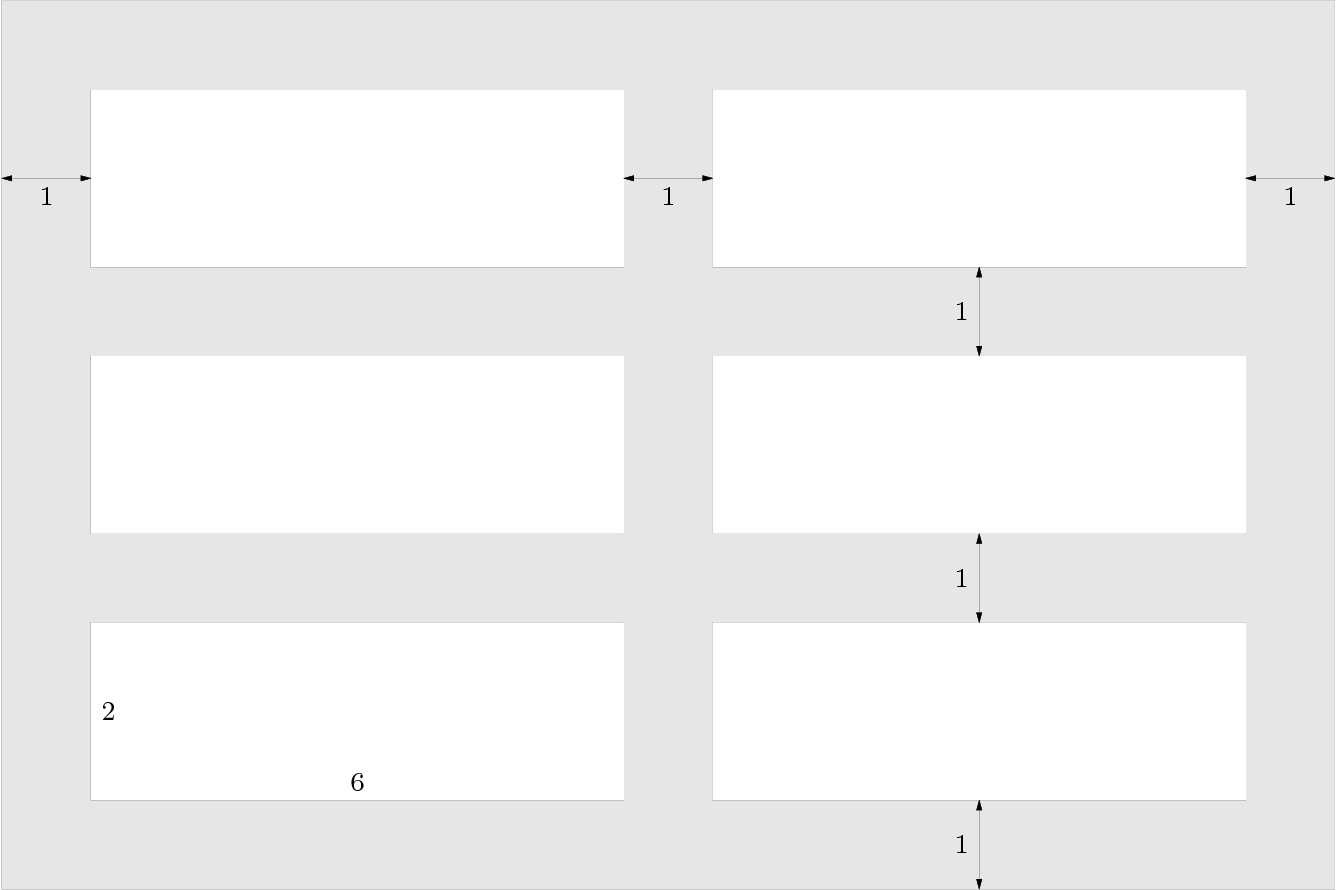
Tamara has three rows of two -feet by -feet flower beds in her garden. The beds are separated and also surrounded by -foot-wide walkways, as shown on the diagram. What is the total area of the walkways, in square feet?
- A)
- B)
- C)
- D)
- E)
Answer
B
Key insight
Find the size of the whole garden, including every walkway strip, then subtract the six flower beds. What is left over is the walkway.
Solution
The walkways have an awkward shape, but the whole garden is a simple rectangle. So find the whole garden's area and take away the beds.
1. Width of the garden. Going left to right you cross a walkway, a bed, a walkway, a bed, a walkway:
2. Height of the garden. Going bottom to top you cross four walkways and three beds:
3. Area of the garden: square feet.
4. Area of the beds. Each bed is square feet, and there are beds, so the beds cover square feet.
5. Walkways are everything that is not a bed:
The answer is .
Why this works
When a region has a messy shape, look for a simple shape that contains it and subtract the pieces that do not belong. The only place to slip is counting the strips: because the walkways go around the outside too, each direction has one more walkway than it has beds.
Alternative approach
Add up the strips directly. There are horizontal walkways, each running the full -foot width: square feet. Between them sit short vertical strips in each of the bed rows, each : that is square feet. Total .
The trap
Missing a walkway strip when measuring the garden, such as the outer border. There is always one more walkway than beds across each direction.
Concise solution
Measure the whole garden. Left to right there are two beds of width and three walkways of width (left edge, middle, right edge): feet. Top to bottom there are three beds of height and four walkways: feet.
Total garden area: square feet.
The six beds each measure square feet, for square feet of beds.
Walkways are everything else: .
The answer is .
Review in the AoPS books
- Introduction to Geometry, Chapter 8: Quadrilaterals
- Introduction to Geometry, Chapter 4: Perimeter and Area (§4.2, §4.3)
- Introduction to Geometry, Chapter 9: Polygons (§9.3)
- Introduction to Geometry, Chapter 11: Circles (§11.3)
Techniques
Set up the equation/formula and compute; no special trick needed · Cut the figure into known shapes (triangles, rectangles, sectors)