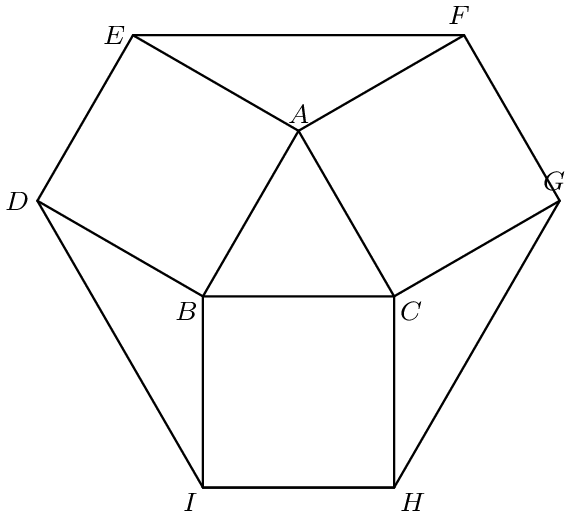
Equilateral has side length , and squares , , lie outside the triangle. What is the area of hexagon ?
- A)
- B)
- C)
- D)
- E)
Answer
C
Key insight
The hexagon splits into the triangle, three unit squares, and three gap triangles with unit legs and a 120-degree apex, each having the same area as the equilateral triangle.
Solution
The hexagon is made of seven pieces: the equilateral triangle, the three squares, and three "gap" triangles at the vertices , , (for example at ).
- Triangle : .
- Three unit squares: .
- Gap triangle at : its sides and are square sides of length . The angles around are two right angles from the squares and from the triangle, so . An isosceles triangle with legs and apex angle has area . (Equivalently, dropping the altitude gives two -- halves with height and base .)
The three gap triangles contribute .
Total area:
The answer is .
Why this works
A polygon built by attaching shapes to a core figure decomposes into the core, the attachments, and the gaps between attachments. The gaps are determined by angle bookkeeping at each vertex: the full minus the angles already used. A isosceles triangle with unit legs has the same area as a unit equilateral triangle, a fact that recurs whenever squares are built on the sides of an equilateral triangle.
The trap
Forgetting the three gap triangles between the squares, which gives 3 + root 3 / 4, or treating them as right triangles.
Common mistakes
- Forgetting the three gap triangles between the squares, which gives 3 + root 3 / 4, or treating them as right triangles.
- Using instead of , which shrinks each gap triangle to .
Techniques
Cut the figure into known shapes (triangles, rectangles, sectors)