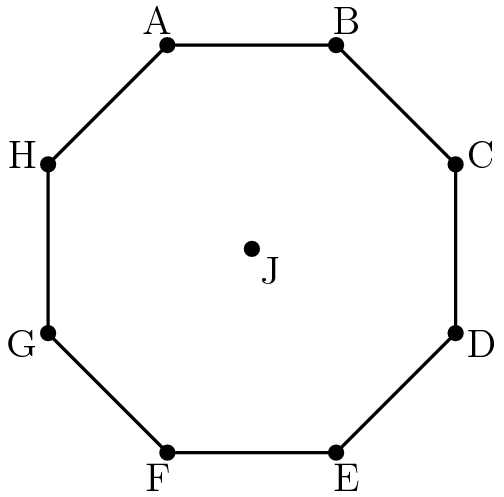
The regular octagon has its center at . Each of the vertices and the center are to be associated with one of the digits through , with each digit used once, in such a way that the sums of the numbers on the lines , , , and are all equal. In how many ways can this be done?
- A)
- B)
- C)
- D)
- E)
Answer
C
Key insight
The center is on every line, so opposite pairs need equal sums; 45-J divisible by 4 forces J in {1,5,9}, then 4!*2^4 each.
Solution
Each of the four lines passes through the center , so its sum is plus the sum of a pair of opposite vertices. The lines have equal sums exactly when the four opposite pairs all have the same pair-sum .
The eight vertex numbers are everything except , so . Thus must be a multiple of , which happens for only.
- : , pairs .
- : , pairs .
- : , pairs .
In every case the eight remaining digits split into four pairs in exactly one way. Assign the four pairs to the four lines: ways. Within each line, decide which end gets which number: ways. Each case contributes labelings.
Total: .
The answer is .
Why this works
A shared element (the center) drops out of every comparison, reducing "four equal line sums" to "four equal pair sums," a partition problem controlled by a divisibility condition. Once the pairs are known, the count is pure arrangement: which pair goes where, and which way round.
The trap
Forgetting that each pair can be flipped (factor 2^4), or that the four pairs can be assigned to the four lines in 4! ways.
Common mistakes
- Forgetting that each pair can be flipped (factor 2^4), or that the four pairs can be assigned to the four lines in 4! ways.
- Counting only one value of (getting , choice (A)) or including values like or that leave not divisible by .
Techniques
Split into exhaustive cases and handle each · Set up the equation/formula and compute; no special trick needed