2012 AMC 10B Problem 25
A bug travels from A to B along the segments in the hexagonal lattice pictured below. The segments marked with an arrow can be traveled only in the direction of the arrow, and the bug never travels the same segment more than once. How many different paths are there?
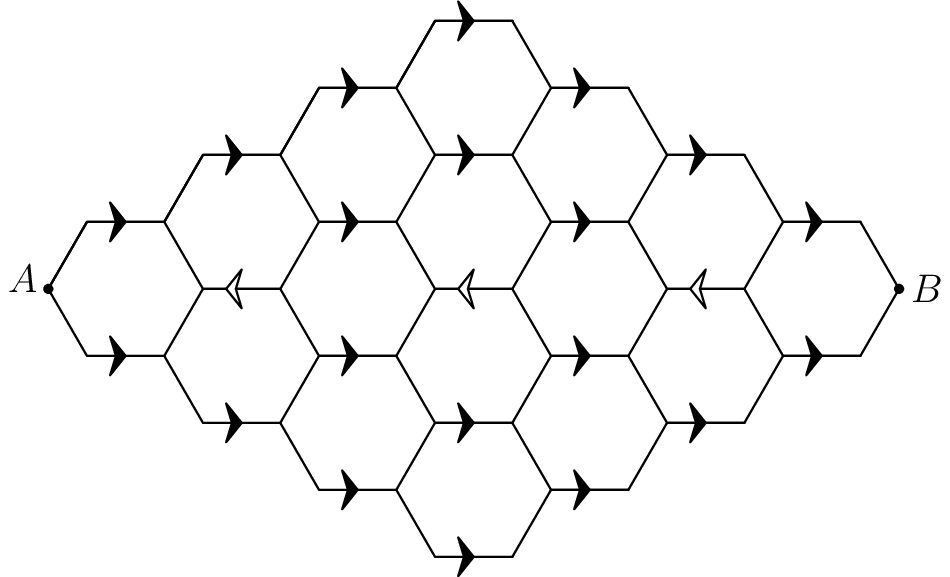
Show solution without answering
Key insight
After the bug crosses an arrow in the 1st, 3rd, 5th or 7th column it can never go back. So count routes one stage at a time and multiply.
Solution
Set-up. Number the columns of right-pointing arrows from left to right. They hold arrows. Columns , and also have one left-pointing arrow on the middle line.
1. Why stages help. Look at the far end of any arrow in columns , , or . Every segment leaving it leads right, and the backward arrows only reach points between these columns. So once the bug passes through one of these arrows, it can never get back to anything on the left. That means every path uses exactly one arrow from each of columns , , , , and what the bug does after a checkpoint arrow doesn't depend on how it got there. We can count one stage at a time and multiply.
2. Column 1. There is way to reach each of its two arrows (straight from ).
3. Column 1 to column 3. Start at the end of the top column-1 arrow. The bug can:
- cross the top column-2 arrow and go on to either top-half column-3 arrow;
- slip down through the middle point to the bottom half, cross the bottom column-2 arrow, and climb back up through the next middle point to a top-half column-3 arrow;
- cross the top column-2 arrow, come down through the middle point, and go to a bottom-half column-3 arrow;
- slip down to the bottom half and cross the bottom column-2 arrow, reaching a bottom-half column-3 arrow directly;
- cross the top column-2 arrow, come down to the middle, take the backward arrow, drop to the bottom half and cross the bottom column-2 arrow.
Sorting these out, the top column-1 arrow leads to each top-half column-3 arrow in ways and to each bottom-half column-3 arrow in ways. The bottom column-1 arrow is the mirror image. So each column-3 arrow is reached in ways.
4. Column 3 to column 5. Listing routes the same way through the wider middle section: from a column-3 arrow there are routes to each column-5 arrow in the same half and routes to each one in the other half. Each column-5 arrow is fed by two same-half and two other-half column-3 arrows, so it is reached in
5. Column 5 to column 7. From a column-5 arrow there are routes to the column-7 arrow in its half and to the other one. Each column-7 arrow is fed by four column-5 arrows, two from each half:
6. Finish. From each column-7 arrow there is exactly one way to . With two column-7 arrows:
The answer is .
Why this works
One-way arrows act like turnstiles: once the bug goes through certain ones, everything behind it is out of reach and no longer matters. That lets a huge count break into a product of small counts, one per stage. The up-down symmetry of the picture saves more work, since every arrow in the same half of a column gets the same count.
Alternative approach
Use the answer choices. Step 3 shows each column-3 arrow can be reached in exactly ways, and how the bug finishes after that arrow doesn't depend on which of those ways it used. So the total is times some whole number, a multiple of . Among the choices, only ends in or .
Concise solution
A shorter write-up, the way contest solutions are usually written. It may take a different route from the solution above.
The rightward arrows form seven vertical columns holding arrows; columns , , also contain one leftward arrow on the center line.
Key structure: every edge leaving the far end of a column-, , or arrow leads rightward, and the leftward arrows only reach vertices between those checkpoints. So once the bug exits such an arrow it can never return to anything on its left. Every path uses exactly one arrow from each of columns , and the number of routes from a chosen arrow to a chosen arrow two columns ahead does not depend on the earlier route, so the count multiplies stage by stage.
Between checkpoints the bug may go straight through one middle arrow, swap halves (upper/lower) at a center-line vertex, or take the leftward arrow and then the other middle arrow. Enumerating these options, from one checkpoint arrow there are:
- column : routes to each column- arrow in the same half, to each in the opposite half;
- column : routes to each same-half arrow, to each opposite-half arrow;
- column : routes to the same-half arrow, to the other.
By symmetry every arrow in a column has the same count. Column : each. Column : each. Column : each. Column : each. Each column- arrow leads to in one way, so the total is
The answer is .
Review in the AoPS books
- Introduction to Counting & Probability, Chapter 5: More With Combinations (§5.2)
- Introduction to Counting & Probability, Chapter 1: Counting Is Arithmetic
- Intermediate Counting & Probability, Chapter 10: Recursion
- Introduction to Algebra, Chapter 22: Special Manipulations (§22.3)
Similar problems
Problem © Mathematical Association of America (MAA), American Mathematics Competitions. Reproduced for non-commercial educational use. Solution and commentary are original to this site. Also appeared as 2012 12B #22.