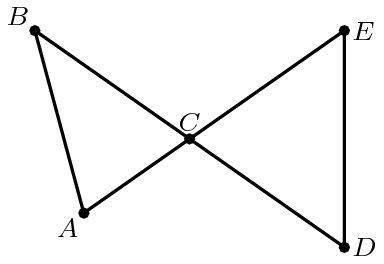
Segment and intersect at , as shown, , and . What is the degree measure of ?
- A)
- B)
- C)
- D)
- E)
Answer
A
Key insight
The equal sides meet at B, so triangle ABC has angles B, and twice five-halves of B, giving B = 30. Vertical angles carry C's angle across.
Solution
The equal sides make two isosceles triangles, one on each side of . Solve the left one first, because we are told how its angles compare.
1. In triangle , sides and are equal. The angles opposite equal sides are equal, so . (The angle at sits between the two equal sides, so it is the odd one out.)
2. Call . Then .
3. The angles of a triangle add to :
so and .
4. Lines and cross at . The angle is directly across from (vertical angles), so it is also .
5. In triangle , sides and are equal, so . These two angles share what is left of :
The answer is .
Why this works
Equal segments mean isosceles triangles, and in an isosceles triangle one angle tells you the other two. The crossing point passes an angle from one triangle to the other, because vertical angles are equal. The one thing to get right is which angle sits between the two equal sides; the other two angles are the matching pair.
The trap
Treating angle B as one of the two equal base angles of triangle ABC, when it is the angle between the equal sides AB and BC.
Concise solution
In triangle , the sides and are equal, so the base angles at and are equal. Let ; then , and the angle sum gives
So .
Since are collinear and are collinear, is vertical to , hence also .
In triangle , the sides and are equal, so the base angles at and are equal:
The answer is .
Review in the AoPS books
- Introduction to Geometry, Chapter 2: Angles
- Introduction to Geometry, Chapter 4: Perimeter and Area (§4.2)
- Introduction to Geometry, Chapter 9: Polygons (§9.1, §9.2)
- Introduction to Geometry, Chapter 6: Right Triangles (§6.1, §6.2, §6.3)
Techniques
Set up the equation/formula and compute; no special trick needed