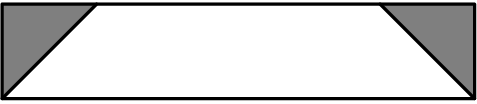
A rectangular yard contains two flower beds in the shape of congruent isosceles right triangles. The remainder of the yard has a trapezoidal shape, as shown. The parallel sides of the trapezoid have lengths and meters. What fraction of the yard is occupied by the flower beds?
- A)
- B)
- C)
- D)
- E)
Answer
C
Key insight
The two triangle bases fill the 25 - 15 = 10 meters left over on the long side, so each leg is 5, which is also the yard's width.
Solution
The long side of the yard is the trapezoid's long base, . The short base, , sits along the top edge between the two triangles, so the two triangles together take up meters of the top edge, or each.
Each flower bed is an isosceles right triangle with one leg along the top edge, so both legs are . The other leg runs along the side of the yard, which means the yard is meters wide.
Areas: each triangle is , so the beds total . The yard is . The fraction is .
The answer is .
Why this works
"Isosceles right triangle" is a strong hint: one measured leg gives everything else. The difference between the trapezoid's bases is shared by the two congruent triangles, and the leg length doubles as the rectangle's width, so a single number unlocks all areas.
Alternative approach
The trapezoid has area out of , leaving for the beds: again .
The trap
Using 10 as the leg of each triangle instead of splitting the 10 meters between the two congruent triangles.
Common mistakes
- Using 10 as the leg of each triangle instead of splitting the 10 meters between the two congruent triangles.
- Computing the fraction of the trapezoid rather than of the whole yard, giving .
Techniques
Cut the figure into known shapes (triangles, rectangles, sectors)