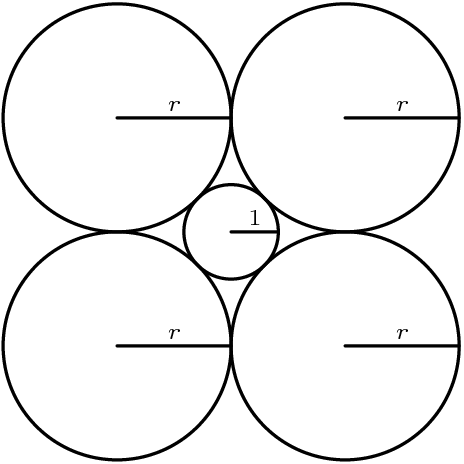
A circle of radius is surrounded by circles of radius as shown. What is ?
- A)
- B)
- C)
- D)
- E)
Answer
B
Key insight
The four outer centers form a square of side 2r whose half-diagonal, r sqrt(2), is the center-to-center distance 1 + r.
Solution
Connect the centers of the four outer circles. Adjacent outer circles are tangent, so neighboring centers are apart, and by symmetry the four centers form a square of side centered at the small circle's center .
The distance from to a corner of that square is half the diagonal:
But each outer circle is also tangent to the central circle, so that same distance equals the sum of the radii, . Therefore
The answer is .
Why this works
Tangent-circle problems become polygon problems once you join the centers: every tangency is a segment of known length (sum of radii). Here the square of centers gives two expressions for the same distance, one from geometry () and one from tangency ().
Alternative approach
Look at the right isosceles triangle formed by and two adjacent outer centers: its legs are and its hypotenuse is , so , again giving . Numerically , and only choice (B) is close.
The trap
Using the square's side or a leg of the wrong triangle as 1 + r, producing r = 1 or r = sqrt(2).
Common mistakes
- Using the square's side or a leg of the wrong triangle as 1 + r, producing r = 1 or r = sqrt(2).
- Stopping at without rationalizing and failing to match it to .
Techniques
Add construction lines/points (drop altitudes, extend segments, connect centers) · Set up the equation/formula and compute; no special trick needed