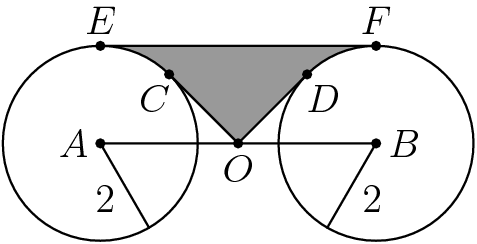
Circles centered at and each have radius , as shown. Point is the midpoint of , and . Segments and are tangent to the circles centered at and , respectively, and is a common tangent. What is the area of the shaded region ?
- A)
- B)
- C)
- D)
- E)
Answer
B
Key insight
Draw AE and BF: the shaded region is rectangle ABFE minus two isosceles right triangles (legs 2) and two 45-degree sectors of radius 2.
Solution
Draw radii , , , . Since is tangent to both circles at their topmost points, and are perpendicular to and to , so is a rectangle with and height : area .
The shaded region is this rectangle with four pieces cut away from the bottom corners and the middle: triangle , sector , triangle , and sector .
Triangle : is tangent at , so . With and , the Pythagorean theorem gives . So is an isosceles right triangle with area , and .
Sector : and , so the sector spans : area .
By symmetry the pieces at are identical. Subtract everything:
The answer is .
Why this works
Regions bounded by tangent segments and arcs are rarely computable directly; enclose them in a rectangle built from radii to the tangent points and subtract triangles and sectors. The tangent-radius right angle supplies the triangle's shape, and the triangle's acute angle tells you the sector's angle. Given with radius , the angle is the designed simplification.
The trap
Taking the sectors as 90 degrees (quarter circles) instead of 45 degrees, or forgetting that OC = 2 makes triangle ACO isosceles right.
Common mistakes
- Taking the sectors as degrees (quarter circles) instead of degrees, or forgetting that makes triangle isosceles right.
- Using (the half-length ) for the rectangle's width, which halves the term.
Techniques
Add construction lines/points (drop altitudes, extend segments, connect centers) · Cut the figure into known shapes (triangles, rectangles, sectors)