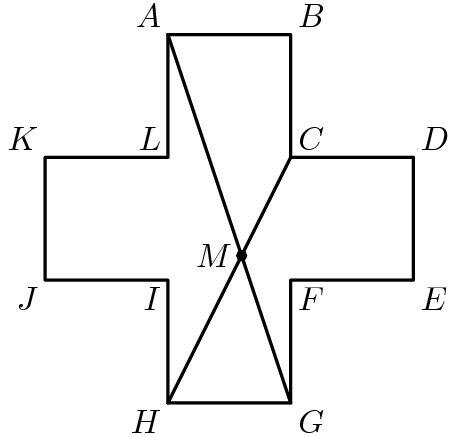
Consider the -sided polygon , as shown. Each of its sides has length , and each two consecutive sides form a right angle. Suppose that and meet at . What is the area of quadrilateral ?
- A)
- B)
- C)
- D)
- E)
Answer
C
Key insight
ABCM is triangle ABG minus triangle CMG; similar triangles AMH and GMC (ratio 12 : 8) put M at horizontal distance 8/5 from line BG.
Solution
The vertices form a rectangle: is horizontal, and are vertical, and lies on segment with , .
Locate . Segments and are both vertical, hence parallel, so triangles and are similar (vertical angles at , alternate interior angles elsewhere). Their ratio is , so 's distances to the parallel lines and are in ratio . Those distances total , so is from line .
Now decompose. Diagonal cuts the rectangle into two triangles; has area . Quadrilateral is triangle with triangle removed. Triangle has base and height (the distance from to line ), so its area is .
The answer is .
Why this works
Two crossing segments between parallel lines create a pair of similar triangles whose ratio is read off from the parallel segments' lengths, which pins down the crossing point. Irregular quadrilaterals are then handled by subtraction from a triangle or rectangle whose area is trivial. Recognize the "hourglass" (two triangles meeting at a vertex between parallels) and its ratio is the key.
Alternative approach
Coordinates with : , , , . Line is and line is ; they meet at . Shoelace on gives .
The trap
Assuming M is the midpoint of AG or of CH, or computing the area of triangle ACM alone and forgetting the rest of the quadrilateral.
Common mistakes
- Assuming is the midpoint of or of , or computing the area of triangle alone and forgetting the rest of the quadrilateral.
- Using the ratio as (confusing with ), which places at distance from and gives area .
Techniques
Place the figure on coordinates and compute · Cut the figure into known shapes (triangles, rectangles, sectors)