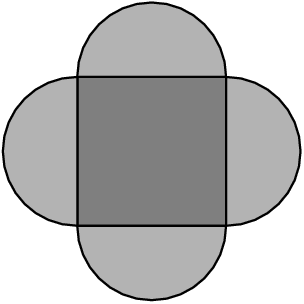
A region is bounded by semicircular arcs constructed on the side of a square whose sides measure , as shown. What is the perimeter of this region?
- A)
- B)
- C)
- D)
- E)
Answer
D
Key insight
Each square side is the diameter of one half-circle. Half of pi times 2/pi is exactly 1, so the four arcs total 4.
Solution
1. First decide what the perimeter is. The outside edge of the region is made only of the four curved arcs. The square's sides are inside the shaded shape, so they do not count.
2. Each arc is half of a circle drawn on one side of the square. That side goes straight across the circle, so it is the diameter: .
3. A full circle has circumference . Here that is
4. Each arc is half a circle, so its length is .
5. There are four arcs, so the perimeter is .
The answer is .
Why this works
The strange side length is a hint: it was picked so the in the circumference formula cancels and the arcs come out to whole numbers. Perimeter means only the outside boundary, so always check which lines are really on the edge of the shape.
The trap
Adding the square's sides to the perimeter (they are inside the region, not on its edge), or using the side as the radius instead of the diameter.
Concise solution
The boundary of the region consists only of the four semicircular arcs; the square's sides are interior to the region.
Each arc is built on a side of the square, so that side is the arc's diameter, . A full circle of diameter has circumference , so a semicircle has arc length
Four arcs give a perimeter of .
The answer is .
Review in the AoPS books
- Introduction to Geometry, Chapter 11: Circles
- Introduction to Geometry, Chapter 12: Circles and Angles
- Introduction to Geometry, Chapter 13: Power of a Point
Techniques
Set up the equation/formula and compute; no special trick needed