A triangle is partitioned into three triangles and a quadrilateral by drawing two lines from vertices to their opposite sides. The areas of the three triangles are 3, 7, and 7, as shown. What is the area of the shaded quadrilateral?
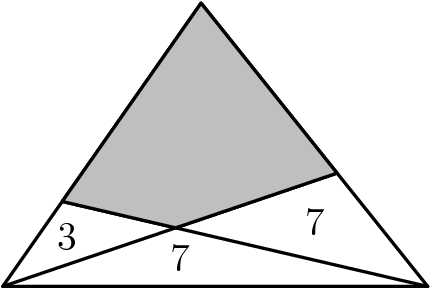
- A)
- B)
- C)
- D)
- E)
Answer
D
Key insight
Draw a line from the top corner to where the two lines cross. Triangles with the same height have areas in the ratio of their bases.
Solution
1. Name the points. Call the big triangle : bottom left, bottom right, at the top. One line goes from to on side ; the other goes from to on side . They cross at . The given areas are: triangle , triangle , triangle . The shaded quadrilateral is .
2. Split the quadrilateral. Draw . It cuts the quadrilateral into two triangles. Call their areas (triangle ) and (triangle ). The answer is .
3. The tool. If two triangles have the same height (same top point, bases on the same line), their areas compare the same way their bases do. For example, if one base is twice as long, that area is twice as big.
4. Along the line . Triangles and both have top point and bases and on the same line. Their areas are both , so .
5. Now look at triangles and . Both have top point and the equal bases and , so their areas are equal:
6. Along the line . Triangles and both have top point , with bases and . Their areas are and , so .
7. Now look at triangles and , both with top point and bases and . Their areas are and , so
8. Solve. Put into the second equation: , so and . Then .
9. The quadrilateral has area .
The answer is .
Why this works
When lines from the corners cut a triangle into pieces with known areas, each crossing point splits a line in some ratio. That ratio shows up in the triangles on both sides of the line, once with known areas and once with unknown ones. Drawing the extra segment from the third corner turns the quadrilateral into two triangles, so you get exactly two equations for the two unknowns.
The trap
Assuming the two lines are medians or guessing from the pattern of 3, 7, 7. Nothing says the lines cut the sides in half, so the areas must be worked out.
Concise solution
Label the triangle with bottom-left, bottom-right, on top. The cevians are ( on ) and ( on ), meeting at . The given areas are , , ; the shaded quadrilateral is .
Draw , cutting the quadrilateral into and . Use one fact repeatedly: two triangles with the same altitude have areas proportional to their bases.
Along : and both have apex , so . Then and (apex , equal bases) are equal:
Along : with apex , so . Then with apex ,
Substitute : , so and . The quadrilateral has area .
The answer is .
Review in the AoPS books
- Introduction to Geometry, Chapter 7: Special Parts of a Triangle
- Introduction to Geometry, Chapter 4: Perimeter and Area (§4.2)
- Introduction to Geometry, Chapter 3: Congruent Triangles
- Introduction to Geometry, Chapter 19: Problem Solving Strategies in Geometry (§19.1)
Techniques
Add construction lines/points (drop altitudes, extend segments, connect centers) · Set up the equation/formula and compute; no special trick needed