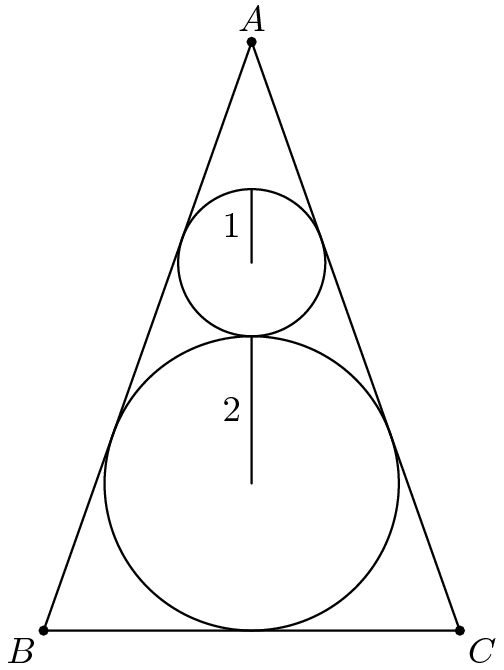
A circle of radius is tangent to a circle of radius . The sides of are tangent to the circles as shown, and the sides and are congruent. What is the area of ?
- A)
- B)
- C)
- D)
- E)
Answer
D
Key insight
From the apex the circles are similar in ratio 1:2, so AO_2 = 2 AO_1 with AO_2 − AO_1 = 3; hence AO_1 = 3, height 8.
Solution
Let (radius ) and (radius ) be the centers; both lie on the axis of symmetry from down to , the midpoint of . Draw the radii from and to their tangent points on ; each is perpendicular to .
This creates two right triangles sharing the angle at , with legs and opposite that angle. They are similar with ratio , so . The circles touch, so , i.e. . Together: and .
The height of the triangle is then .
In the small right triangle, hypotenuse and leg give the other leg , so . In right triangle ,
Area: .
The answer is .
Why this works
Circles inscribed in an angle are all similar from the vertex's point of view: their centers lie on the bisector and their radii scale with the distance to the vertex. That ratio, combined with the fixed distance between the centers, pins down every length. Drawing the radius to the tangent point is the standard move that turns tangency into a right triangle.
Alternative approach
Coordinates: put at the origin and . Side is tangent to the circle centered with radius ; for the line through with slope , distance from equals , so and . Same area .
The trap
Using the center-to-center distance 3 as the apex-to-small-center distance, or forgetting to add the bottom radius 2 below O_2 when finding the height.
Common mistakes
- Using the center-to-center distance as the apex-to-small-center distance, or forgetting to add the bottom radius below when finding the height.
- Treating the big circle as the incircle and applying with the wrong or without knowing the sides.
Techniques
Add construction lines/points (drop altitudes, extend segments, connect centers) · Set up the equation/formula and compute; no special trick needed