Equilateral has side length , is the midpoint of , and is the midpoint of . What is the area of ? 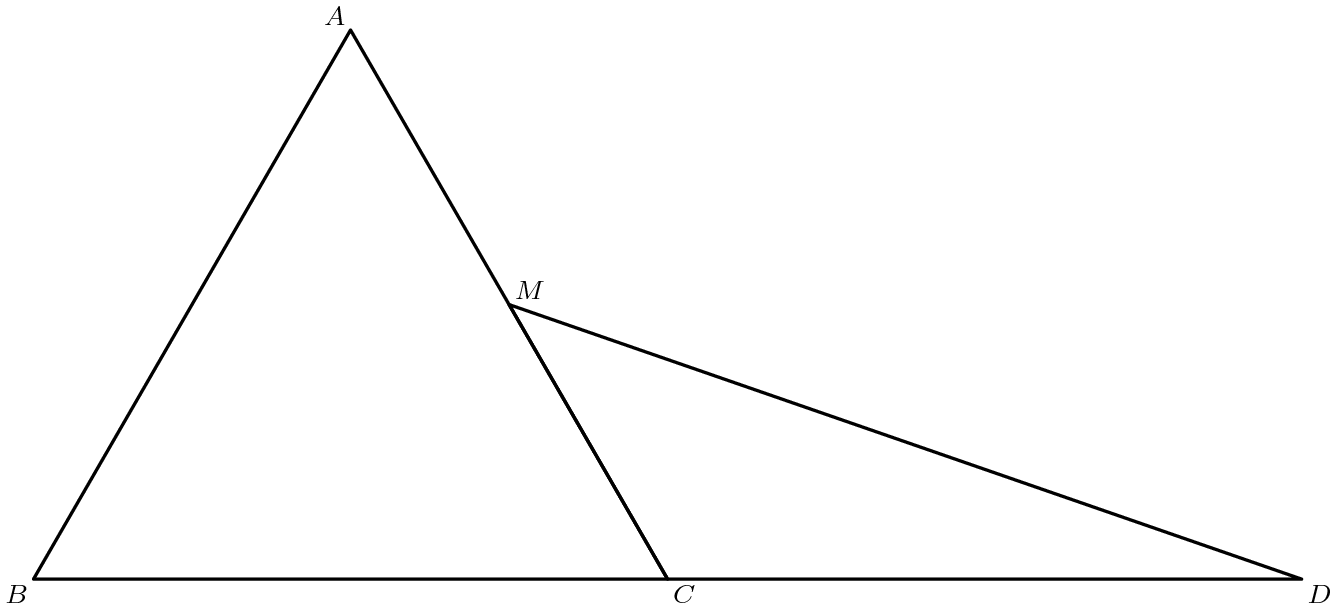
- A)
- B)
- C)
- D)
- E)
Answer
C
Key insight
Use CD = 2 as the base; the height from M to line BD is half the height of the equilateral triangle, sqrt3/2, since M is a midpoint.
Solution
Take as the base of . Since is the midpoint of , .
For the height, measure the distance from to line . Point is at height above line (the altitude of an equilateral triangle of side ), and is on the line at height . Because is the midpoint of , its height is the average, .
Therefore
The answer is .
Why this works
Choosing the base that lies along a known line makes the height a single vertical distance, and a midpoint sits at the average of the heights of its endpoints. Equivalently, has the same base length as and half its height, so its area is half of .
Alternative approach
Trigonometry: , with and , so the area is .
The trap
Treating MC as the height of triangle CDM, or using the full equilateral height sqrt3 instead of half of it.
Common mistakes
- Treating MC as the height of triangle CDM, or using the full equilateral height sqrt3 instead of half of it.
- Using correctly but a wrong pair of sides, e.g. and , which doubles the area.
Techniques
Add construction lines/points (drop altitudes, extend segments, connect centers) · Cut the figure into known shapes (triangles, rectangles, sectors)