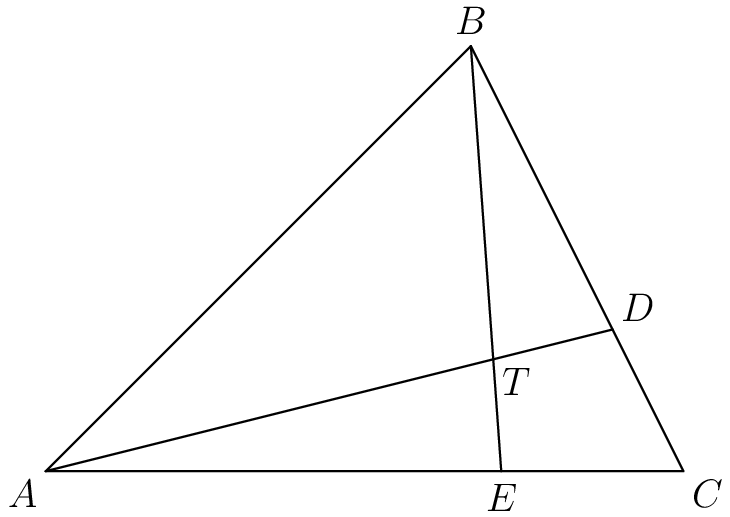
In points and lie on and , respectively. If and intersect at so that and , what is ?
- A)
- B)
- C)
- D)
- E)
Answer
D
Key insight
Mass points: A = 5, D = 15 and B = 4, E = 16 both balance at T = 20; then C = 11 and CD/BD = 4/11.
Solution
Use mass points. Hang weights on the vertices so that is the balance point of both cevians.
On : , so the weight at must be three times the weight at . On : , so the weight at is four times the weight at . The total weight at must agree along both cevians, so choose
lies on and its weight is the sum of the weights at and , so . Consistency check: lies on and , matching the weight already assigned to .
On segment , the foot divides it inversely to the end weights:
The answer is .
Why this works
A problem that gives only ratios along two cevians and asks for a ratio on a side is the textbook setting for mass points: each cevian is a lever balanced at , and the lever law converts length ratios into weights and back. The one subtlety is scaling the two levers so that carries the same total weight from each.
Alternative approach
Area ratios. Take and (they share the altitude from and ). Then . Since , . Triangles and share base , so their areas are in the ratio of the distances from and to line , which is . Hence , so .
The trap
Using masses from the two cevians on inconsistent scales (T must receive the same total from both), or reading off BD/CD = 4/11 and inverting the requested ratio.
Common mistakes
- Using masses from the two cevians on inconsistent scales (T must receive the same total from both), or reading off BD/CD = 4/11 and inverting the requested ratio.
- Assuming and are midpoints or that is the centroid, and answering a ratio like or that is not even offered.
Techniques
Set up the equation/formula and compute; no special trick needed