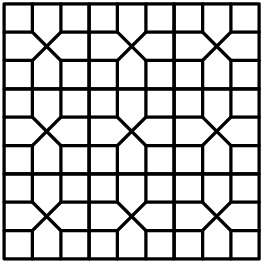
The plane is tiled by congruent squares and congruent pentagons as indicated. The percent of the plane that is enclosed by the pentagons is closest to
- A)
- B)
- C)
- D)
- E)
Answer
D
Key insight
One repeating 3 by 3 block has area 9, of which the four corner unit squares take 4, so the four pentagons cover 5/9, about 55.6 percent.
Solution
The tiling repeats: the picture is made of identical blocks (measured in units of the small square's side), so the fraction covered by pentagons in one block is the fraction for the whole plane.
Take one block, area . It contains four unit squares, one in each corner, with total area . Everything else in the block belongs to the four pentagons (each pentagon is a unit square along an edge plus a quarter of the central unit square, area ), so the pentagons cover .
The pentagon share is , i.e. about , and the nearest choice is .
The answer is .
Why this works
For a periodic pattern, "percent of the plane" equals "percent of one fundamental block," which turns an infinite question into finite arithmetic. Counting the simple pieces (the squares) and subtracting is easier than computing the odd-shaped pieces directly. The answer choices are close together, so estimate only after an exact fraction is in hand.
The trap
Estimating from the picture instead of measuring one block, or counting the central square as part of the squares (it is split among the pentagons).
Common mistakes
- Estimating from the picture instead of measuring one block, or counting the central square as part of the squares (it is split among the pentagons).
- Computing the square share and picking the choice nearest to that, or rounding down to .
Techniques
Cut the figure into known shapes (triangles, rectangles, sectors)