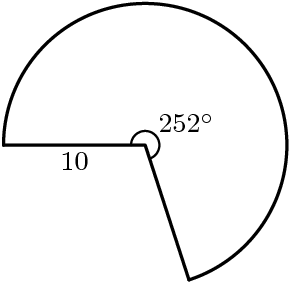
Which of the cones listed below can be formed from a sector of a circle of radius by aligning the two straight sides?
- A)
- B)
- C)
- D)
- E)
Answer
C
Key insight
The sector's radius becomes the slant height and its arc becomes the base circumference: (252/360)(20 pi) = 14 pi, so the base radius is 7.
Solution
When the two straight edges are glued together, every radius of the sector runs from the apex of the cone down to its rim. So the slant height of the cone is ; this rules out (B) and (D), which describe the height.
The curved edge of the sector wraps around to become the circle at the base of the cone. Its length is the fraction of the full circumference :
A circle of circumference has radius .
The answer is .
Why this works
Rolling a sector into a cone preserves lengths: radius to slant height, arc to base circumference. Both conversions are one-line computations once you identify which piece becomes which. The ratio "central angle over " equals "base radius over slant height," a fact worth remembering for any cone-net problem.
Alternative approach
Match areas: the sector has area , and a cone's lateral area is with . Then gives .
The trap
Treating the sector radius 10 as the cone's height rather than its slant height, which points to choices (B) or (D).
Common mistakes
- Treating the sector radius 10 as the cone's height rather than its slant height, which points to choices (B) or (D).
- Using the arc length as the base diameter or as the radius, giving or forcing a guess between (A) and (E).
Techniques
Set up the equation/formula and compute; no special trick needed