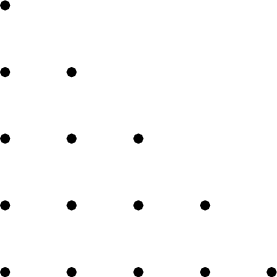
There are 5 yellow pegs, 4 red pegs, 3 green pegs, 2 blue pegs, and 1 orange peg to be placed on a triangular peg board. In how many ways can the pegs be placed so that no (horizontal) row or (vertical) column contains two pegs of the same color?
- A)
- B)
- C)
- D)
- E)
Answer
B
Key insight
Five yellow pegs need five distinct rows and columns on a board with exactly five of each, so their spots are forced, and so is every other color.
Solution
The board has rows (lengths ) and columns (lengths ), fifteen holes in all, one per peg.
Start with the most constrained color. The five yellow pegs must occupy five different rows and five different columns. The single-hole column has one spot, so a yellow peg goes there; that uses its row too. The two-hole column now has one spot left outside that row, so its yellow peg is forced; and so on. Yellow is placed in exactly one way, along the "long diagonal."
Remove those holes. What remains is a board with rows of lengths and columns of lengths , and the four red pegs face the identical situation, so they are forced as well. Repeating for green, blue and orange fills the board uniquely.
The answer is .
Why this works
When the number of identical objects equals the number of rows and columns available, "one per row and one per column" leaves no freedom on a triangular board. Attack the tightest constraint first; each forced placement shrinks the board to the same shape one size smaller, an induction in disguise.
The trap
Treating pegs of the same color as distinguishable and multiplying factorials, which produces choices (C) or (E).
Common mistakes
- Treating pegs of the same color as distinguishable and multiplying factorials, which produces choices (C) or (E).
- Answering after failing to find a placement, without trying the forced diagonal construction.
Techniques
Consider the largest/smallest element or boundary case · Use an invariant, parity, or coloring argument