Problems 21–25 challenge
20 late problems for after everything else is solid
- 1.2025 AMC 10A #21
A set of numbers is called sum-free if whenever and are (not necessarily distinct) elements of the set, is not an element of the set. For example, and the empty set are sum-free, but is not. What is the greatest possible number of elements in a sum-free subset of ?
- A)
- B)
- C)
- D)
- E)
- A)
- 2.2002 AMC 10A #21
The mean, median, unique mode, and range of a collection of eight integers are all equal to 8. The largest integer that can be an element of this collection is
- A)
- B)
- C)
- D)
- E)
- A)
- 3.2003 AMC 10A #24
Sally has five red cards numbered through and four blue cards numbered through . She stacks the cards so that the colors alternate and so that the number on each red card divides evenly into the number on each neighboring blue card. What is the sum of the numbers on the middle three cards?
- A)
- B)
- C)
- D)
- E)
- A)
- 4.2003 AMC 10B #22
A clock chimes once at minutes past each hour and chimes on the hour according to the hour. For example, at there is one chime and at noon and midnight there are twelve chimes. Starting at on on what date will the chime occur?
- A)
- B)
- C)
- D)
- E)
- A)
- 5.2005 AMC 10B #25
A subset of the set of integers from to , inclusive, has the property that no two elements of sum to . What is the maximum possible number of elements in ?
- A)
- B)
- C)
- D)
- E)
- A)
- 6.2010 AMC 10B #24
A high school basketball game between the Raiders and Wildcats was tied at the end of the first quarter. The number of points scored by the Raiders in each of the four quarters formed an increasing geometric sequence, and the number of points scored by the Wildcats in each of the four quarters formed an increasing arithmetic sequence. At the end of the fourth quarter, the Raiders had won by one point. Neither team scored more than points. What was the total number of points scored by the two teams in the first half?
- A)
- B)
- C)
- D)
- E)
- A)
- 7.2010 AMC 10A #23
Each of 2010 boxes in a line contains a single red marble, and for , the box in the position also contains white marbles. Isabella begins at the first box and successively draws a single marble at random from each box, in order. She stops when she first draws a red marble. Let be the probability that Isabella stops after drawing exactly marbles. What is the smallest value of for which ?
- A)
- B)
- C)
- D)
- E)
- A)
- 8.2011 AMC 10A #23
Seven students count from 1 to 1000 as follows:
- Alice says all the numbers, except she skips the middle number in each consecutive group of three numbers. That is, Alice says 1, 3, 4, 6, 7, 9, ..., 997, 999, 1000.
- Barbara says all of the numbers that Alice doesn't say, except she also skips the middle number in each consecutive group of three numbers.
- Candice says all of the numbers that neither Alice nor Barbara says, except she also skips the middle number in each consecutive group of three numbers.
- Debbie, Eliza, and Fatima say all of the numbers that none of the students with the first names beginning before theirs in the alphabet say, except each also skips the middle number in each of her consecutive groups of three numbers.
- Finally, George says the only number that no one else says.
What number does George say?
- A)
- B)
- C)
- D)
- E)
- 9.2011 AMC 10A #24
Two distinct regular tetrahedra have all their vertices among the vertices of the same unit cube. What is the volume of the region formed by the intersection of the tetrahedra?
- A)
- B)
- C)
- D)
- E)
- A)
- 10.2013 AMC 10A #21
A group of pirates agree to divide a treasure chest of gold coins among themselves as follows. The pirate to take a share takes of the coins that remain in the chest. The number of coins initially in the chest is the smallest number for which this arrangement will allow each pirate to receive a positive whole number of coins. How many coins does the pirate receive?
- A)
- B)
- C)
- D)
- E)
- A)
- 11.2015 AMC 10A #25
Let be a square of side length . Two points are chosen at random on the sides of . The probability that the straight-line distance between the points is at least is , where , , and are positive integers with . What is ?
- A)
- B)
- C)
- D)
- E)
- A)
- 12.2015 AMC 10A #23
The zeroes of the function are integers. What is the sum of the possible values of ?
- A)
- B)
- C)
- D)
- E)
- A)
- 13.2016 AMC 10A #25
How many ordered triples of positive integers satisfy and ?
- A)
- B)
- C)
- D)
- E)
- A)
- 14.2016 AMC 10B #23
In regular hexagon , points , , , and are chosen on sides , , , and respectively, so lines , , , and are parallel and equally spaced. What is the ratio of the area of hexagon to the area of hexagon ?
- A)
- B)
- C)
- D)
- E)
- A)
- 15.2020 AMC 10A #24
Let be the least positive integer greater than for which What is the sum of the digits of ?
- A)
- B)
- C)
- D)
- E)
- A)
- 16.2024 AMC 10A #21
The numbers, in order, of each row and the numbers, in order, of each column of a array of integers form an arithmetic progression of length . The numbers in positions , , and are , , , and , respectively. What number is in position ?
- A)
- B)
- C)
- D)
- E)
- A)
- 17.2012 AMC 10B #25
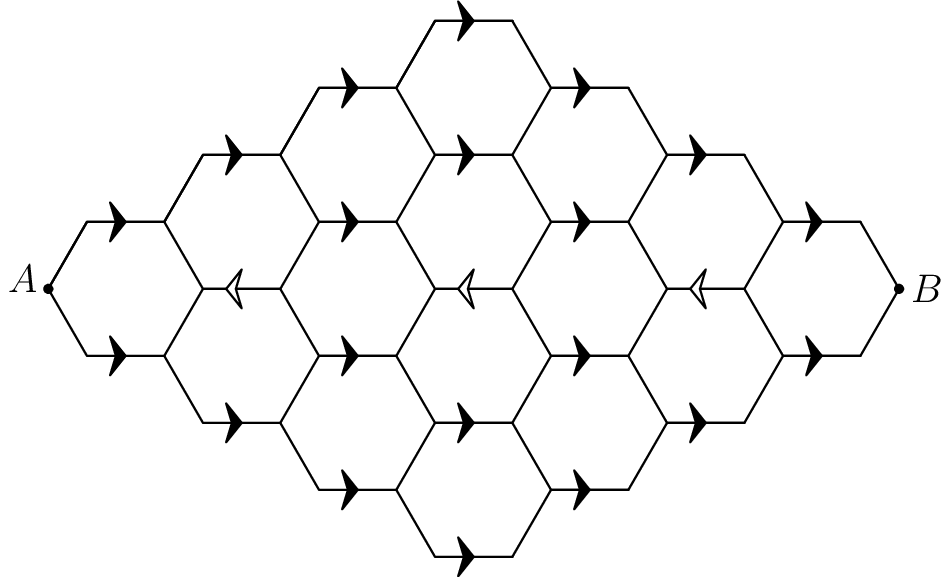
A bug travels from A to B along the segments in the hexagonal lattice pictured below. The segments marked with an arrow can be traveled only in the direction of the arrow, and the bug never travels the same segment more than once. How many different paths are there?
- A)
- B)
- C)
- D)
- E)
- A)
- 18.2014 AMC 10A #25
The number is between and . How many pairs of integers are there such that and
- A)
- B)
- C)
- D)
- E)
- A)
- 19.2023 AMC 10B #25
A regular pentagon with area is printed on paper and cut out. All five vertices are folded to the center of the pentagon, creating a smaller pentagon. What is the area of the new pentagon?
- A)
- B)
- C)
- D)
- E)
- A)
- 20.2025 AMC 10B #25
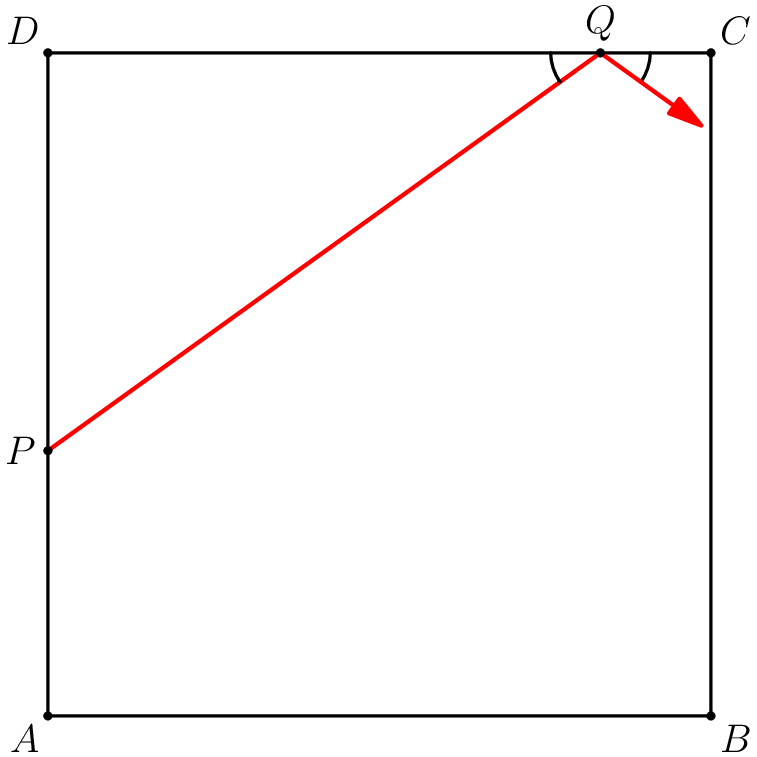
Square has sides of length . Points and lie on and , respectively, with and . A path begins along the segment from to and continues by reflecting against the sides of (with congruent incoming and outgoing angles). If the path hits a vertex of the square, it terminates there; otherwise it continues forever. At which vertex does the path terminate?
- A)
- B)
- C)
- D)
- E)
- A)
Answers
| # | Answer | Topic and the idea it turns on |
|---|---|---|
| 1 | C | Number Properties — If m is the largest element of a sum-free set S, then S minus {m} and its mirror about m are disjoint in {1, ..., m-1}, so 2(|S|-1) <= 19. |
| 2 | D | Statistics & Data — Mean fixes the sum at 64, range ties the minimum to max minus 8, and unique mode forces enough 8s to outnumber the repeated low values. |
| 3 | E | Logic Puzzles — Red 5 divides only blue 5 and red 4 only blue 4, so those reds sit at the ends; the rest of the stack is forced card by card. |
| 4 | B | Clocks, Calendars & Time — A full day has 180 chimes and the rest of Feb 26 has 91; 1912 = 10 * 180 + 112 lands on the eleventh day, March 9. |
| 5 | C | Sets, Estimation & Miscellaneous — Numbers 1 to 24 are never in a bad pair; 25 to 100 form 38 pairs summing to 125, each giving at most one element: 24 + 38 = 62. |
| 6 | E | Sequences & Series — The 100-point cap leaves only ratios 2, 3, 4, 3/2 with tiny first terms; requiring 4a+6d one less singles out a=5, r=2. |
| 7 | A | Conditional Probability & States — Box k holds k + 1 marbles, so drawing white at boxes 1 through n-1 and red at box n has probability (1/2)(2/3)...((n-1)/n) * 1/(n+1), which telescopes to 1/(n(n+1)). |
| 8 | C | Games & Processes — The unsaid numbers always form an arithmetic progression; each skip sends (first term, step) to (a + d, 3d), producing 2, 5, 14, 41, 122, 365. |
| 9 | D | Solid Geometry — Each tetrahedron's edges are face diagonals meeting at face centers, so one tetrahedron's faces slice half-scale corners off the other, leaving 1/3 - 4/24 = 1/6. |
| 10 | D | Divisibility & Factors — After pirate k the chest holds (12-k)/12 of what it held, so the last pirate gets N*11!/12^11; the minimal N cancels all of 12^11 not covered by 11!. |
| 11 | A | Geometric Probability — Condition on which sides hold the points: same side (prob 1/4, success 1/4), adjacent (1/2, success 1 - pi/16), opposite (1/4, always); total (26 - pi)/32. |
| 12 | C | Quadratics — By Vieta rs = 2(r + s), hence (r - 2)(s - 2) = 4; the factor pairs of 4, negatives included, give a = 9, 8, 0, -1. |
| 13 | A | GCD & LCM — Work one prime at a time: each lcm condition fixes the maximum of two exponents, and the counts for primes 2, 3, 5 (5, 3, 1) multiply. |
| 14 | C | Quadrilaterals & Polygon Areas — WCXYFZ is the middle third of the hexagon between two parallel lines; the top and bottom thirds are trapezoids of area 8/27 each, leaving 11/27. |
| 15 | C | GCD & LCM — The gcds mean 21 | n+120 but not 9, and 60 | n+63 but not 8; solve n = 237 mod 420, then test 1077, 1497, 1917. |
| 16 | C | Sequences & Series — Rows and columns all arithmetic makes the entry a bilinear function A + Bi + Cj + Dij; the four given entries fix the constants, and (1,2) gives 29. |
| 17 | E | Paths & Grids — Once the bug exits an arrow in columns 1, 3, 5, 7 it can never go back, so the count multiplies stage by stage: 1, 5, 120, 1200 per arrow. |
| 18 | B | Exponents, Logarithms & Radicals — Each gap between consecutive powers of 5 holds two or three powers of 2; counting 2013 powers of 2 over 867 gaps forces 279 triple gaps. |
| 19 | B | Angles & Polygons — Each crease is the perpendicular bisector of a vertex-to-center segment, so the new pentagon has apothem R/2; its scale factor is 1/(2cos36) = 1/phi, area ratio (3-sqrt5)/2. |
| 20 | B | Transformations & Symmetry — Reflect the square rather than the ray: the path unfolds to a straight line of slope 18/25, dying at the first image point, whose parities name the corner. |